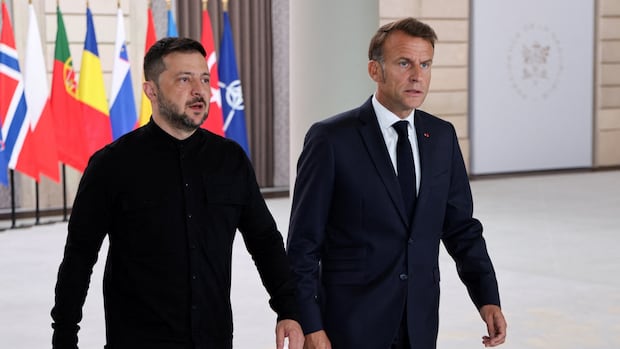
French President Emmanuel Macron said on Thursday that 26 countries have committed to taking part in a reassurance force in Ukraine in the event of a ceasefire.
Some 30 Western leaders held talks in Paris on Thursday with Ukrainian President Volodymyr Zelenskyy over security guarantees for Kyiv in the event of a peace deal with Russia, hoping to do enough to persuade the United States to back their efforts and to get clarity from the White House on what that might entail.
The U.S. has been clear on their will to take part in the security guarantees offered to Ukraine, Macron said, adding the relevant planning work needed to be finalized with Washington.
“[The U.S.] have participated in all the work over the past few weeks on their support and their willingness to be part of the security guarantees, so there is no doubt about this,” he told reporters after meeting with the group known as the “coalition of the willing.”
Macron said the assurances from the countries included commitments for deploying troops in Ukraine — or to maintaining a presence on land, at sea or in the air — to help guarantee the country’s security.
Zelenskyy said that Kyiv and its allies have an understanding of a general framework for security guarantees, and that documents were being prepared in each of the countries that have agreed to contribute.
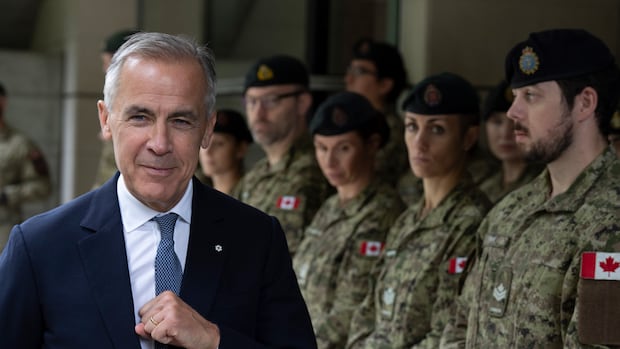
Prime Minister Mark Carney’s suggestion that he won’t rule out sending Canadian troops to Ukraine if a ceasefire deal is reached has been met with reminders of potential obstacles, including Russia not wanting NATO members there as peacekeepers and the fact that the Canadian Armed Forces are already stretched thin.
Members of the coalition, which does not include the U.S., have talked for months at various levels to define their prospective military support for Ukraine to help deter Russia from attacking it again if and when there is a final truce, which is currently still a remote prospect.
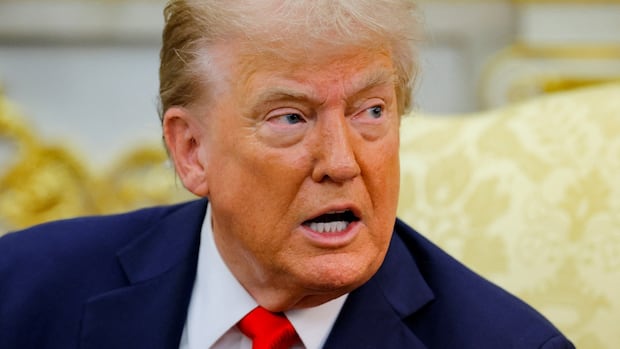
U.S. President Donald Trump has made no explicit commitment publicly, although he has made reference to the U.S. potentially providing air support.
Trump’s special envoy, Steve Witkoff, met French, British, German, Italian and Ukrainian senior diplomats ahead of the summit, before briefly attending the opening session.
The summit brought together leaders from Europe, Australia, Japan and Canada, with even neighbouring countries choosing to attend by video link.
“The prime minister affirmed Canada’s steadfast commitment to the coalition and its willingness to deploy direct and scalable military assistance in support of a ceasefire and lasting peace,” Prime Minister Mark Carney’s office said. “He joined coalition members in emphasizing the need to maintain multilateral economic pressure on Russia to end its aggression.”
On his first trip to Kviv as Canadian prime minister, Carney said last month that “it is not realistic that the only security guarantee could be the strength of the Ukrainian armed forces … that needs to be buttressed and reinforced.”
Canada’s last major role in peacekeeping occurred in Mali, ending in 2023.
Countries such as Poland and Romania are among those that had appeared earlier to rule out putting peacekeeping troops in Ukraine.
Plotting sanctions strategy
The coalition also discussed co-ordinated sanctions, Finland’s president told reporters in that country. Alexander Stubb said Trump in a call with the leaders suggested the U.S. and Europe should act together on further sanctions against Russia, and that sanctions on oil and gas were up for discussion.
“Trump’s approach was very much that we must act together on sanctions policy and now look for ways in particular to halt Russia’s war machine by economic means,” said Stubb.
Trump has warned this summer of “severe consequences” for Russia and President Vladimir Putin if he is not serious about pursuing an end to fighting, although he also greeted him warmly at an Alaska summit last month that ended with a muted and brief news conference.
Trump has ruled out putting American troops on the ground in Ukraine and has repeatedly boasted that his administration has now coaxed European countries to buy arms directly from U.S. defence contractors. No money was allocated for Ukraine in Trump’s signature first-year legislation, whereas Joe Biden’s administration spent over $60 billion US in direct military aid for Ukraine.
NATO Secretary General Mark Rutte said ahead of the meeting that he expected clarity from the coalition soon on what could be delivered, and this would pave the way for more intense discussions with Washington on what guarantees it could provide.
On Thursday, he took aim at the Kremlin, which has said it is emphatically opposed to any foreign deployment in Ukraine.
“Why are we interested in what Russia thinks about troops in Ukraine? It’s a sovereign country. Russia has nothing to do with this,” Rutte said at a conference in Prague before joining the summit on Thursday. “I think we really have to stop making Putin too powerful.”
Russia invaded Ukraine in February 2022, and it is believed each country has suffered military losses of hundreds of thousands of service members.
Putin told Kyiv on Wednesday there was a chance to end the war in Ukraine via negotiations “if common sense prevails,” an option he said he preferred, although he was ready to end it by force if that was the only way.